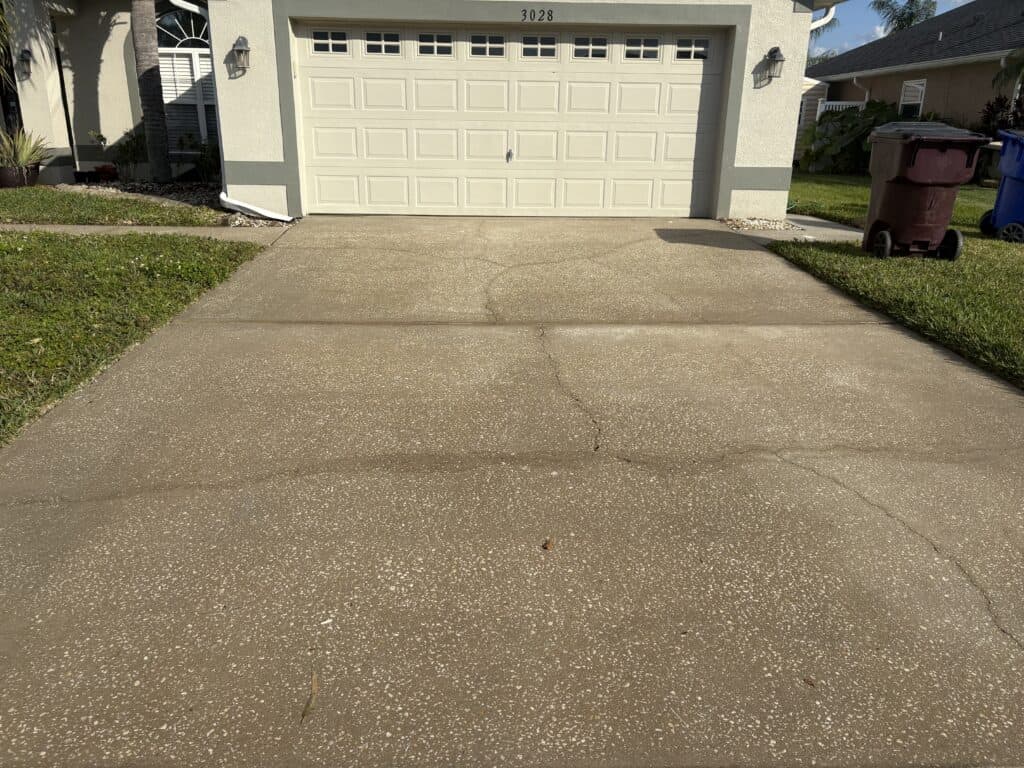
Concrete cleaning is usually the better option when a concrete surface is structurally sound but covered with dirt, algae, mildew, stains, or general buildup. Replacement makes more sense when the concrete has severe cracking, major settlement, widespread spalling, exposed reinforcement, or other physical deterioration that cleaning cannot correct. In some cases, concrete repair can provide a middle option between cleaning and full replacement.
Summary:
- Choose concrete cleaning when the main problem is surface dirt, algae, mildew, staining, or discoloration and the concrete remains stable and intact.
- Consider repair or replacement when you see major cracking, sinking, uneven sections, widespread crumbling, spalling, or exposed reinforcement.
- Inspect before deciding because cleaning, repair, and replacement address different problems, and a dirty surface does not automatically mean the concrete itself has failed.
Concrete can stay in place for many years, but that does not mean every stained, cracked, or worn surface needs to be removed and replaced. If your driveway, walkway, patio, parking area, or other concrete surface is looking rough, the first question should be what is actually wrong with it. Dirt, algae, oil, tire marks, mold, and weather-related staining are very different problems from deep cracking, sinking, or serious structural deterioration.
For many properties, professional concrete cleaning is enough to restore a surface that is still in good physical condition. Replacement makes more sense when the concrete itself has failed or when the underlying problem cannot be solved with cleaning or repair. Knowing the difference can save you from spending thousands of dollars on work you may not need, while also helping you avoid putting off a replacement when the surface is no longer a good candidate for cleaning.
Concrete cleaning and concrete replacement solve different problems
The simplest way to compare the two options is to ask whether the problem is mainly on the surface or within the concrete.
Concrete cleaning removes buildup from the outside of the slab. Pressure washing can help remove dirt, mud, algae, mildew, grime, some organic growth, and other surface contaminants. It can make a driveway, sidewalk, patio, or commercial concrete area look substantially better without changing the slab itself.
Concrete replacement is different. It involves removing the existing concrete and installing new material. That is a much larger project and is normally considered when the concrete has significant physical damage, movement, settlement, or deterioration that cleaning cannot correct.
A useful rule is simple: if the concrete is dirty but still sound, cleaning may be the sensible first step. If the concrete is badly damaged, unstable, or failing, replacement may be necessary.
When concrete cleaning is usually the better choice
The surface is stained but still solid
A concrete driveway can collect years of dirt, vehicle residue, leaf debris, algae, and other buildup. The surface may look old even when the slab underneath is still in decent condition.
If you do not see major movement, widespread cracking, crumbling edges, or large areas that have broken away, cleaning is worth considering before replacement. A proper pressure washing process can remove a significant amount of surface buildup and give you a much clearer view of the concrete’s actual condition.
This is especially useful when you are preparing a home for sale, improving the appearance of an older property, or simply trying to maintain the exterior without taking on a major construction project.
Algae, mildew, and organic growth are the main problem
Florida’s warm, humid conditions can make outdoor concrete prone to biological growth and staining. Walkways, driveways, pool decks, patios, and shaded areas can become dark or slippery when buildup is allowed to remain for long periods.
Cleaning can address this type of surface problem without replacing the slab. The exact cleaning approach should depend on the material, condition, and type of buildup. High pressure is not automatically better, especially when a surface is already damaged or has a delicate finish.
The concrete has normal surface wear
Older concrete can become dull, discolored, or dirty without being structurally compromised. Small cosmetic imperfections do not automatically mean the entire slab needs to be demolished.
A professional cleaning can help you judge the condition more accurately. Once years of grime are removed, it becomes easier to see whether cracks are minor surface issues or signs of a larger problem.
You want to maintain concrete before problems become harder to manage
Regular exterior cleaning is part of property maintenance. Keeping driveways, sidewalks, patios, and other concrete areas free from heavy buildup can improve appearance and make changes in the surface easier to notice.
For homeowners in St. Cloud, Kissimmee, Lake Nona, Narcoossee, Buenaventura Lakes, Hunters Creek, Meadow Woods, Southchase, and Poinciana, concrete cleaning can be a practical part of routine exterior maintenance. The same applies to commercial properties in Orlando, Winter Park, Altamonte Springs, Sanford, Oviedo, Winter Garden, Ocoee, Davenport, and Celebration.
When replacement may make more sense

Cleaning cannot restore concrete that has physically failed. If the slab has serious damage, a new surface may be the more practical long-term solution.
Large or deep cracks are spreading
Not every crack means replacement. Concrete naturally develops some cracking, and the right response depends on the cause, size, location, and extent of the damage.
The American Concrete Institute notes that concrete cracking should be evaluated based on factors such as its cause, extent, and effect on durability and performance. Cracks can provide pathways for water and other damaging agents to enter the concrete, so they should not simply be covered up without understanding why they formed.
If cracks are extensive, repeatedly reopening, associated with movement, or accompanied by other signs of failure, cleaning is not going to solve the underlying issue. A qualified concrete professional may need to determine whether repair or full replacement is appropriate.
The slab is sinking or uneven
A pressure washer can clean an uneven driveway, but it cannot make the slab level again.
If sections of concrete have settled, lifted, shifted, or developed noticeable changes in elevation, the problem may involve the supporting soil, drainage, roots, or other site conditions. These issues need to be addressed separately from surface cleaning.
Uneven sidewalks also deserve attention because changes in elevation can create trip hazards. If a slab is moving or has significantly changed position, replacement or another appropriate concrete repair method may be more suitable than simply cleaning it.
Concrete is crumbling or spalling across large areas
Spalling occurs when sections of the concrete surface break away, leaving rough or exposed areas. Small, isolated damage can sometimes be repaired, but widespread deterioration requires closer evaluation.
The American Concrete Institute’s repair guidance explains that deteriorated concrete should be evaluated to determine the cause and that repair methods depend on the extent and type of damage. For larger or deeper deterioration, more substantial repair methods may be required.
If large sections are crumbling, exposing reinforcement, or losing material, replacement may ultimately be more practical than repeated surface repairs.
The slab has major structural or drainage problems
Concrete can fail because of more than age. Poor drainage, repeated water exposure, soil movement, construction issues, heavy loads, and other conditions can contribute to deterioration.
If water repeatedly collects around or beneath a slab, replacing the concrete without addressing the cause may only provide a temporary improvement. Before committing to replacement, it is worth identifying why the concrete is failing.
Concrete cleaning vs. replacement at a glance
| Condition | Concrete Cleaning | Replacement or Repair |
|---|---|---|
| Dirt and general grime | Usually appropriate | Usually unnecessary |
| Algae or mildew buildup | Usually appropriate | Usually unnecessary |
| Oil or surface staining | May be appropriate | Usually unnecessary |
| Minor cosmetic discoloration | Usually appropriate | Usually unnecessary |
| Small isolated cracks | Cleaning may help appearance, but does not repair cracks | Repair may be considered |
| Deep or widespread cracking | Will not solve the problem | Professional evaluation recommended |
| Major settling or uneven sections | Does not correct movement | Repair or replacement may be needed |
| Extensive spalling or crumbling | Cannot restore lost concrete | Repair or replacement may be needed |
| Exposed reinforcement | Cleaning is not a solution | Professional concrete evaluation recommended |
| Concrete that is sound but dirty | Strong candidate for cleaning | Replacement is generally excessive |
What should you do before deciding?
Start with a visual inspection before looking at prices.
Look at the entire surface rather than focusing on the dirtiest section. Check for cracks, changes in elevation, broken edges, loose material, exposed reinforcement, standing water, and areas where the concrete appears to be separating or sinking.
Then consider what has changed over time. Has the surface simply become darker and dirtier? Or have cracks grown, sections shifted, and pieces started breaking away?
If the problem is mainly surface contamination, cleaning is a reasonable first step. If the concrete is moving or deteriorating, cleaning should not be presented as a replacement for concrete repair.
This distinction matters because pressure washing is a cleaning service, not a concrete reconstruction service. A good cleaning can improve the appearance of sound concrete, but it cannot fill a structural crack, stabilize a sinking slab, or replace concrete that has already broken away.
How pressure washing fits into concrete maintenance
Concrete cleaning is not limited to driveways. Different exterior surfaces around a property can accumulate similar buildup.
For residential properties, Residential Pressure Washing Services can cover outdoor areas where dirt and organic growth collect over time. Driveway & Sidewalk Pressure Washing is especially useful for high-traffic concrete that receives regular foot and vehicle use.
Patios and outdoor living areas can also benefit from Deck & Patio Pressure Washer Cleaning when dirt, algae, and weather-related buildup have affected their appearance. Other exterior surfaces, such as siding, brick, and stucco, require cleaning methods suited to their materials, which is why House Exterior Power Washing should not be approached exactly like concrete cleaning.
Commercial properties have different maintenance demands. Parking Lot & Commercial Building Power Washing can help address accumulated dirt and grime around larger exterior areas, while Commercial Power Washing Services may be appropriate for businesses that need routine exterior cleaning across multiple surfaces.
Roof cleaning is another separate application. Roof Soft Washing & Pressure Washing Services should use a method appropriate for the roofing material rather than treating the roof like a concrete driveway.
A practical way to decide
If you are unsure whether your concrete needs cleaning or replacement, start with the least invasive option that can reasonably address the problem.
If the slab appears sound and the main issue is dirt, stains, algae, or general discoloration, have the surface assessed for professional cleaning. If cleaning reveals extensive cracking, movement, crumbling, or other deterioration, that is the point to speak with a qualified concrete professional about repair or replacement.
If you are in the Orlando area and want to see what condition your concrete is actually in before making a larger decision, a professional cleaning assessment can be a useful starting point. It lets you separate surface buildup from physical damage instead of assuming that a dirty driveway needs to be replaced.
Does pressure washing damage concrete?

It can if the wrong pressure, nozzle, distance, or technique is used.
Concrete is durable, but it is not indestructible. Excessive pressure or poor technique can damage the surface, especially when the concrete is already weakened, aged, cracked, or has a decorative finish.
A professional cleaner should consider the condition of the concrete before choosing a cleaning method. The goal is to remove contaminants without unnecessarily damaging the surface.
This is one reason a quick inspection matters. If the concrete is already deteriorating, aggressive cleaning may expose loose material or make existing damage more noticeable. That does not mean cleaning caused the underlying failure. It may simply reveal a problem that was hidden beneath dirt and buildup.
Can cleaning make old concrete look new again?
Cleaning can make old concrete look significantly better, but it cannot make damaged concrete new.
A dirty but structurally sound driveway may respond very well to cleaning. Removing years of grime can restore a cleaner, more consistent appearance and make the property look better maintained.
However, cleaning will not reverse settlement, replace missing concrete, correct major cracks, or rebuild deteriorated sections. If those problems are present, cleaning may still be useful as part of maintenance, but it should not be treated as a substitute for concrete work.
The best result comes from matching the service to the actual problem.
Why replacing clean-looking concrete can still be the wrong decision
Replacement is expensive, disruptive, and often unnecessary when the existing slab is still sound.
It can involve demolition, hauling away old material, preparing the base, forming the new area, pouring concrete, finishing, curing, and coordinating access to the property. The exact process varies depending on the project.
If the only problem is staining or buildup, removing a serviceable slab does not address a real need. Cleaning is usually a much simpler way to improve the appearance.
On the other hand, keeping severely damaged concrete just because cleaning is cheaper can also be a mistake. If the slab has serious movement or deterioration, spending money repeatedly on cosmetic cleaning will not correct the underlying condition.
What about concrete repair instead of full replacement?
There is also a middle option: repair.
Not every damaged slab needs to be completely removed. Depending on the cause and extent of the damage, certain cracks, spalls, or localized defects may be repairable.
The American Concrete Institute recommends evaluating the condition and underlying causes before selecting a repair method. Different repair techniques are suited to different types and levels of deterioration.
That means your decision is not always simply “clean or replace.” In some cases, the more sensible sequence is clean, inspect, repair where appropriate, and replace only the sections that cannot reasonably be restored.
Final decision: clean first when the concrete is still sound
For most homeowners and property managers, the decision comes down to the condition of the concrete itself.
If the surface is mainly dirty, stained, or covered with algae and the slab remains solid and stable, concrete cleaning is usually the sensible first option. If the concrete has major cracks, widespread spalling, significant settlement, exposed reinforcement, or other signs of physical failure, cleaning will not solve the underlying problem and professional repair or replacement may be necessary.
The important part is not choosing the cheaper option automatically. It is choosing the option that matches the actual condition of the concrete.
For properties throughout St. Cloud, Kissimmee, Lake Nona, Narcoossee, Buenaventura Lakes, Hunters Creek, Meadow Woods, Southchase, Poinciana, Celebration, Orlando, Winter Park, Altamonte Springs, Sanford, Oviedo, Winter Garden, Ocoee, and Davenport, regular exterior cleaning can help keep concrete and other outdoor surfaces looking maintained. Just remember that cleaning and concrete replacement serve different purposes.
Frequently Asked Questions
How often should a concrete driveway be cleaned?
The ideal schedule depends on weather, shade, drainage, traffic, surrounding landscaping, and how quickly dirt or organic growth returns. A driveway in a shaded, damp area may need attention sooner than one that stays dry and receives more direct sunlight.
Should you seal concrete after pressure washing?
Sealing can be appropriate for some concrete surfaces, but it is not required after every cleaning. The right product and timing depend on the condition and type of concrete, the existing finish, and how the surface will be used. If sealing is being considered, follow the product manufacturer’s preparation and application instructions.
Can pressure washing remove all oil stains from concrete?
Not always. Oil can penetrate porous concrete, so cleaning may reduce the appearance of a stain without removing it completely. Results depend on how old the stain is, how deeply it has penetrated, and what cleaning method is used.
Is concrete replacement covered by homeowners insurance?
It depends on the cause of the damage, the policy, exclusions, and the circumstances of the loss. Normal aging and maintenance issues are generally treated differently from damage caused by a covered event. Review your policy and speak with your insurance provider for a decision about your specific situation.
Can new concrete be poured directly over old concrete?
Sometimes an overlay or new layer may be possible, but it is not a universal solution. The condition, thickness, stability, drainage, and intended use of the existing surface all matter. A concrete professional should evaluate the existing slab before deciding whether an overlay is appropriate.